Saturday, June 22, 2013

Yellowtail Crudo "Watercolor" - Inspiration

I am often asked where inspiration comes from for the dishes that we create.

Sometimes it is more obvious than other times.  Without wanting to seem gimmicky, I will often put clues or hints that the guest might be able to figure out for themselves where inspiration came from: a touch of chocolate cookie crumb to simulate dirt in a dessert inspired by flowers, or a bit of sea foam or seaweed on a fish dish.


With our Yellowtail Crudo, the intention to produce a dish which would look like a Chinese watercolor-inspired painting, evolved alongside our desire to produce this dish, with these components.  In the end, the two concepts merged to create the Crudo "Watercolor"


The paints determine the flavor profile:
Basil Oil
Plum Vinegar
Horseradish Cream


The Chinese characters translate (extremely roughly) to "meet by chance" and reference the way that patches of duckweed drift together on a pond.


The pond is painted on using basil oil and swirls of horseradish cream and populated by thinly sliced Yellowtail.


A drizzle of plum vinegar brings the koi fish Yellowtail to life


A touch of crispy rice pearls to mimic bubbles on the surface.


A few fallen Basil leaves


A garlic blossom on a peppery nasturtium leaf makes an uncanny lilypad.


Sealed with the restaurant's name in all edible inks


Pretty sick likeness, if I do say!

Most importantly, the flavors work really well, the combination of plum and basil is unique and so summery, but for us, its really special to present these flavors in a context that people will find memorable (hopefully!)


Cool beans.

Saturday, June 15, 2013

Stuffed and Rolled Lamb Chops "Frankenlamb"

Lamb is a tricky ingredient to squeeze into a menu format.  Sourcing can be an issue, as domestic lamb can often be 3-4 times the price of overseas lamb, which is also typically frozen.  The chops are sinewy and have only a couple bites of meat on them.  There are other parts of the lamb with better flavor, moisture and texture, but everyone loves the prettiness of those little meat lollipops.  So the question becomes: how does one serve the perfect portion of lamb, and still maintain the attractive shape and velvety texture of a rack.


At Palo Alto Grill, we serve a dish that we call Stuffed and Rolled Lamb Chops.  It is a combination of three different cuts of meat:

Lamb Merguez Sausage


Rack of Lamb
Lamb Shoulder


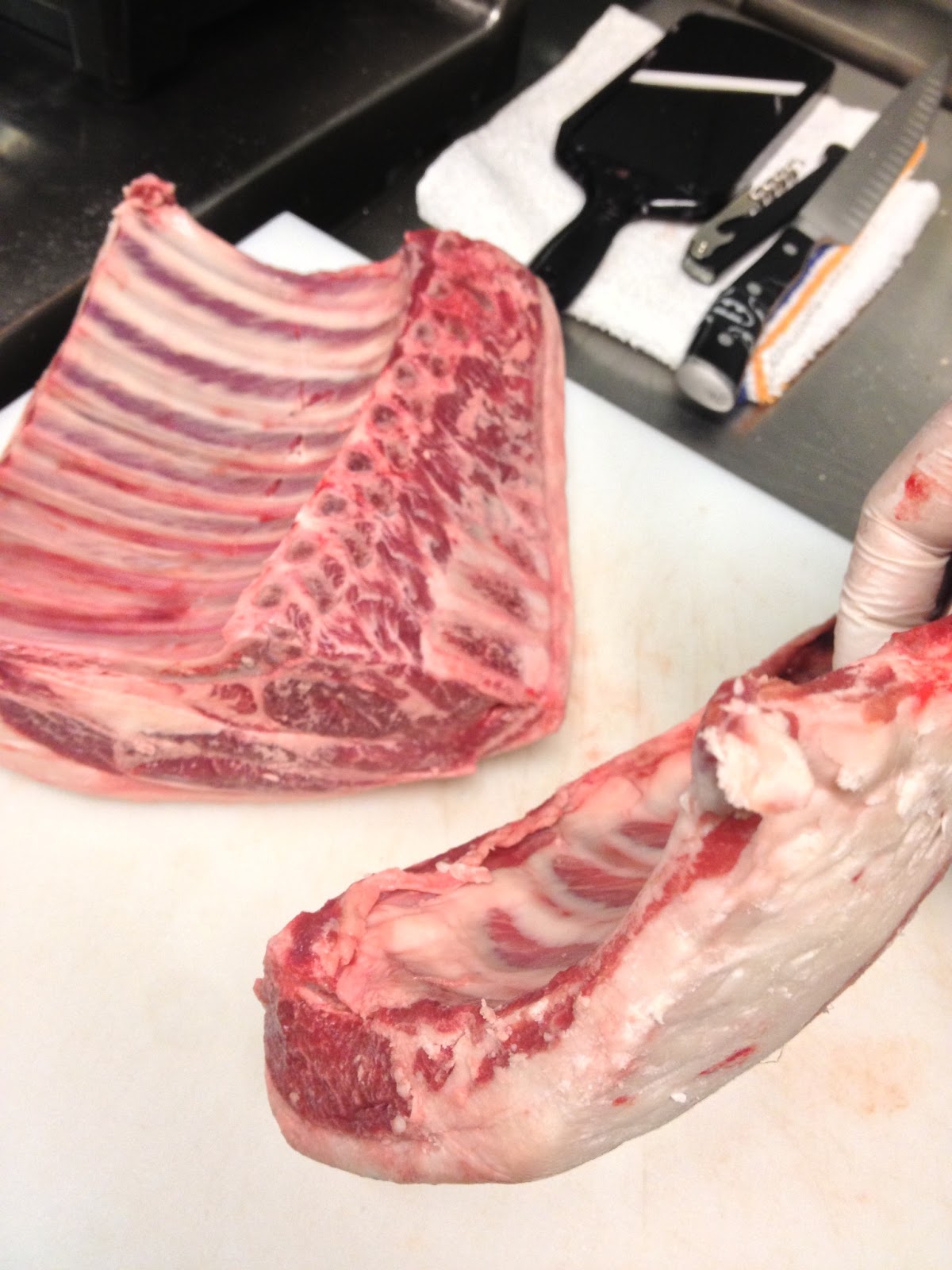
In order to make this dish, first we take the rack of lamb and french it.  In this instance, frenching is a technique which has nothing to do with spinning a bottle.  Instead it is a butchery method which takes the rack of lamb, as it is pictured above and cleans the fat and meat off the bones, so that it looks as it does in the picture to the right.


Racks are traditionally frenched with a boning knife or paring knife, which can be difficult, time-consuming and can wear the edge on a knife.  At Palo Alto Grill, we french with twine, which is a more modern method.  This is a very short video of what that looks like.  (I may give a more detailed lesson in twine-frenching at some point.)


Once the rack is cleaned, poke a small hole all the way through the loin, first with a knife, then with a steel, to make the hole smooth and not too jagged.  Feed the Merguez into the hole.  (note, the merguez should be cooked and chilled for ease of stuffing)


We then roll the rack in a confit of lamb shoulder.  To confit the shoulder, salt it well before simmering in duck fat.  The duck fat should barely reach above a light simmer, so keep it over very low heat on a stove.  This may take up to 5 hours to completely tenderize the lamb shoulder.  When it is done, it looks like it does in the picture on the right. (once the fat is drained off)  It is fall-apart tender.

To roll the rack in the confit shoulder, lay the confit out on a sheet of plastic wrap, then place the rack in the middle, pull up the sides of the plastic wrap and fold in the excess.


Like this


And this...


After a vacuum seal (with foil to protect the bags from the bones) it looks like the following)


It can then be sous-vide or refrigerated until use, either method would work.  (we sous-vide ours for 4 hours at 140F, which keeps it nicely Medium Rare, or rosey throughout.  After sous-viding, chill in ice bath overnight, for ease of portioning)


After portioning, the rack should look like this:


In its semi-raw state, the layers are clearly visible, the Merguez inside, the rosey chop meat and the confit shoulder on the outside.  After grilling, however, the color becomes more monochrome.


We serve our lamb chops with harissa demi-glace, couscous, cucumber raita, golden raisins marinated in white wine and cilantro.  Most people can't really tell what they're eating when they're eating it, but most agree its pretty sick!


Saturday, June 8, 2013

Corn Puddin' - in video

If a picture is worth 1,000 words, then 3 videos should explain Corn Puddin' better than any recipe, especially because the only ingredient is corn!  Here goes:


That's all it is - corn, shredded on a cheese grater and squeezed dry, then sizzled in a cast iron pan before being broiled brown, topped with a little bit of butter, fleur de sel, and lime.

Sick!

Sunday, May 26, 2013

Crispy Breaded Chicken Breast, Sous Vide

 At Palo Alto Grill, we have a really special way of cooking chicken.  It is crispy and breaded on the outside, yet the inside is tender and succulent, like poached chicken.  We achieve this using a technique called Sous Vide.

I am lucky to have been trained in the science of cooking sous vide by Bruno Chemel of Baumé Restaurant, who taught as the chef instructor of Joël Robuchon's School of Sous Vide in France.  Bruno has continued to practice and perfect the technique of sous vide for over 20 years.  Sous Vide is an interesting process and one which is currently highly controversial.  There are even certain states and cities which consider its use illegal.  Here in California, for a restaurant to cook sous vide, a Chef must first write a very complicated guide, detailing all the processes performed at that restaurant, a copy of which is kept on file at the Health Department.  Ironically, at the same time as all of these regulations get tighter and tighter for the professional, more and more cookbooks and tools are released to the home cook for sous vide cooking!

As most people are aware, in the time before refrigeration, almost all meats were prepared by braising or stewing at extremely high temperatures.  This, of course is if they weren't preserved through curing, confitting or smoking, etc.  Now that refrigeration is a common practice, people are more accustomed to eating meats cooked at a much lower temperature, (medium-rare, rare, raw, etc) a practice once considered very dangerous.  These days, we realize that cooking meat to a lower temperature results in meat which is more moist and more tender.  Sous vide is the next step in this evolution.  Instead of changing the temperature TO which meat is cooked, sous vide changes the temperature AT which meat is cooked.  The reason it is considered such a dangerous process is because many of the chefs who practice sous vide are not properly trained to handle the dangers and exercise the proper controls over these dangers.

Though it may seem small, one of the most important factors to consider in cooking sous vide is the wearing of sterile gloves.  On our hands are two types of bacteria: aerobic and anaerobic.  Most aerobic (oxygen-breathing) bacteria are relatively harmless to people, comparatively.  Because of competition with these stronger aerobic bacteria, anaerobic bacteria (non-oxygen-breathing) have a difficult time thriving and therefore rarely exist in dangerous proportions.  However, when oxygen is removed from an environment (as in canning or sous vide) the aerobic bacteria die and the anaerobic (such as botulism!) thrive.  Therefore, gloves are critical when cooking sous vide.  Most cookbooks and internet websites which teach sous vide miss out on many of these controls and dangers.
Back to the fun stuff:  Chicken.

<-This is a 38 North Brand Bassian Farms Chicken.  It is the finest animal I have ever had the opportunity to work with.  (38 North comes from the fact that these chickens are raised 38 miles north of the Golden Gate)  They are rich and flavorful and the skin adheres beautifully to the flesh, which is very important for this application.


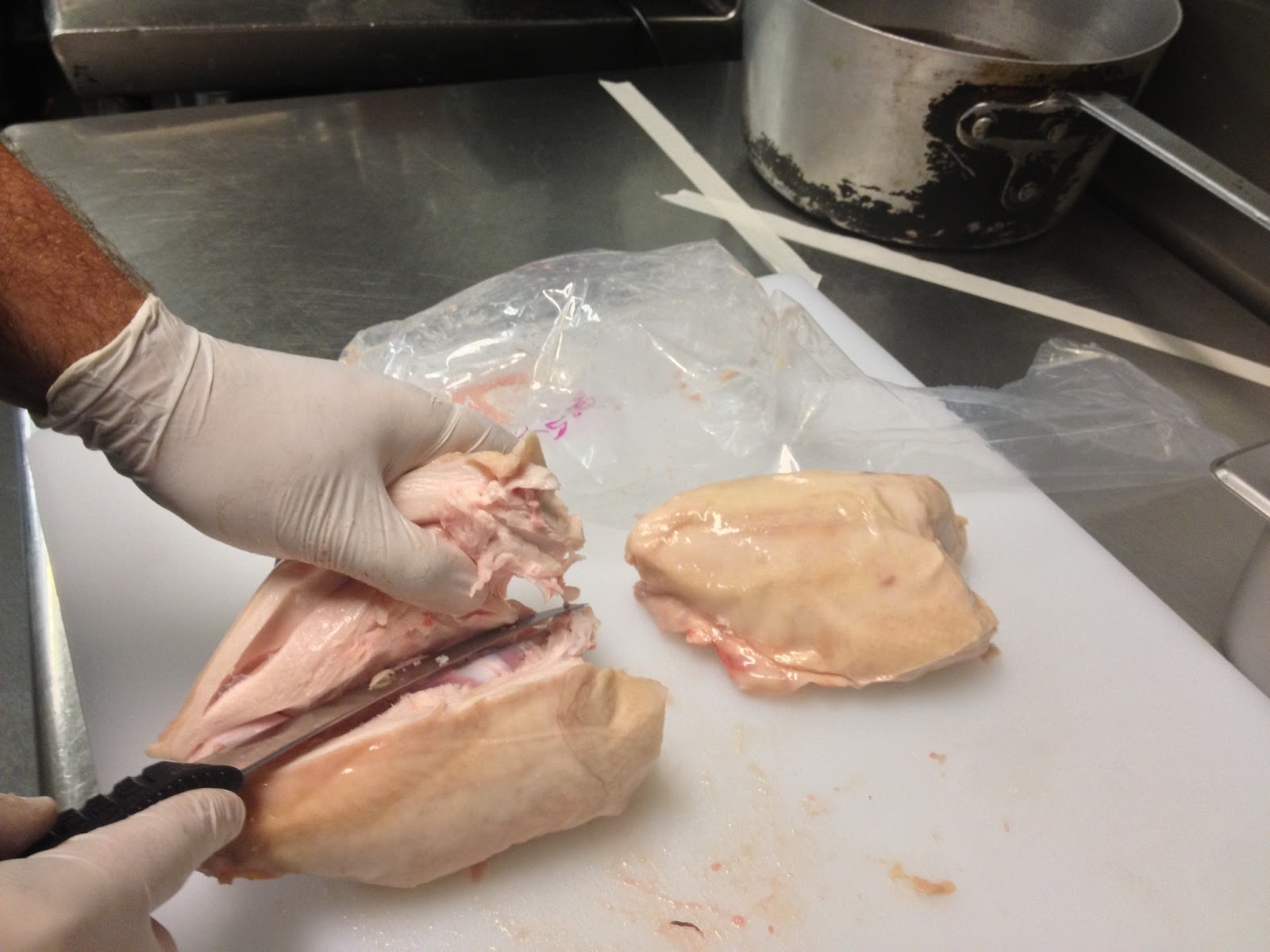
Firstly, break the chicken down as such:


The whole breast will be poached sous vide, the legs grilled for our Chicken Salad on Croissant and the wings and spine saved for stock to make the Dijon Chicken Jus.


 (Note: if for some reason you do not have access to the equipment or materials necessary to prepare this chicken sous vide, a delicate poach or very light simmer in chicken broth for about an hour before chilling, carving and breading would produce an extremely similar product)


To vacuum the breasts, put them back to back, to prevent the bones from tearing the bags under vacuum.  Remember: Cut bones cut bags.


Sous vide the chicken at 145 degrees Fahrenheit for 2.5 hours.


Once it is cooked, chill the chicken in an ice bath before fully chilling in the refrigerator.


Once fully chilled, carve the breasts off of the chicken.


Marinade the breasts for at least 6 hours or overnight in buttermilk and your favorite dry rub or spice mix.  We use our cowboy steak seasoning.


Once the chicken breasts have finished marinating, dredge them in all purpose flour mixed with dry herbs and more spice mix.
 

The chicken can be fried now, but its still better to wait 2-3 hours or until the dredging looks soggy.
<-Like this


Once soggy, dredge lightly once more and fry at 350F until well browned.


Serve with Grilled Apples


 and Dijon jus-glazed Chestnut Biscuits


Halve, and present, moist and glistening, on sauteed greens.

By doing the initial cook on the bone, the chicken maintains its maximum flavor and moisture.


Finish with fleur de sel and baby sage.


Sauce liberally tableside with Dijon Jus.


Cool beans.